How to Save a Webpage as PDF without Cutting Off

Written By Hanzala Saleem
Updated At July 31, 2026 | 7 min read
Written By Hanzala Saleem
Updated At July 31, 2026 | 7 min read
A webpage gets cut off in a PDF because the browser scales the live page to fit a fixed paper size, so wide or long content spills past the printable area. To save a full page with no cut-offs, capture it as one continuous image or PDF. For a one-off, use Chrome Print with "Save as PDF", scale set to "Fit to page", and margins set to "Default". For a single clean page, use a full-page browser extension. For many pages or automation, use a screenshot API with full_page=true and file_type=pdf.
In an earlier post, we showed you how to save a webpage as a PDF without any of those annoying ads. In this post, we’ll flip the script and save a screenshot of an entire page as a PDF without any page breaks or cut-offs.
There are a few reasons why you might want to do this, from getting design inspiration for your own website to checking what your competitors are doing with theirs.
Let’s take a look!
A live webpage scrolls freely, but a PDF has fixed pages. When you print to PDF, the browser forces the flowing page into set paper dimensions, and three things commonly cause clipping.
First, paper size and scale: if scale is locked at 100% instead of "Fit to page", wide layouts run past the right edge.
Second, browser differences: Chrome, Firefox, and Safari each handle print-to-PDF differently, so one may clip where another does not.
Third, page CSS: fixed-width containers, overflow rules, and missing print break rules let the renderer split tables and images at awkward points.
The fix in every case is the same idea: capture the page as one continuous surface, or force the layout to fit the printable area before you export. Most cut-offs trace back to paper size, scale locked at 100%, or CSS that ignores print page breaks. If your goal is a clean file, learn how to print articles without ads before you export.
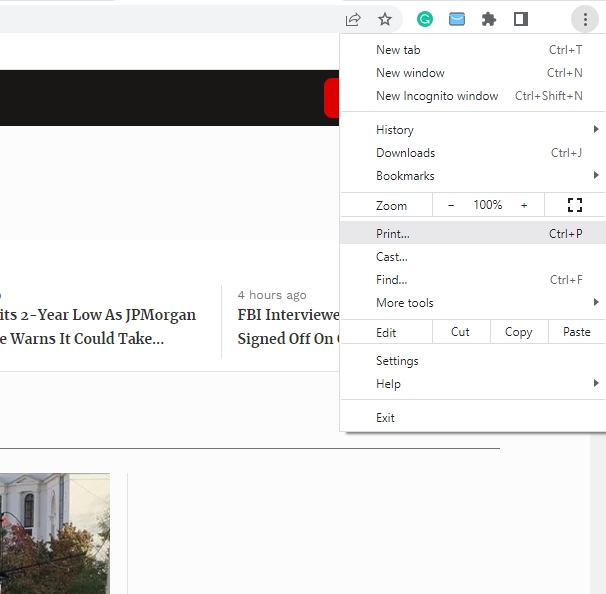
When using this method, you’ll see that your browser splits the page into separate pages. This is pretty efficient and only requires you to select Print -> Save as PDF.
Unfortunately, you won’t get high-resolution screenshots, and you could lose some information on the page.
To solve the problem, you could use a browser extension. There are tons of these extensions available for most browsers, including:
Even though these extensions sound relatively straightforward to use, they have a few problems. For instance, you’ll need to navigate to the site you would like to save a screenshot of. This means that if you want to save several web pages from single or multiple sites, you’ll need to go to the page, take a screenshot, go to the next page, take a screenshot, and so on.
Not exactly efficient, is it?
Another option is to use dedicated PDF editing software, like the paid Adobe Acrobat DC Pro. This software makes it easy to convert an entire website into a single PDF. It’s as easy as clicking a button.
By using the software, you can also add converted pages to an existing PDF file. The drawback of this software is, you guessed it, it can be quite pricey, no matter if you get the standalone version or the Creative Cloud subscription.
Luckily, there is a better option! You can use ScreenshotAPI. Our tool lets you take and save screenshots for any purpose and save them in the format you need.
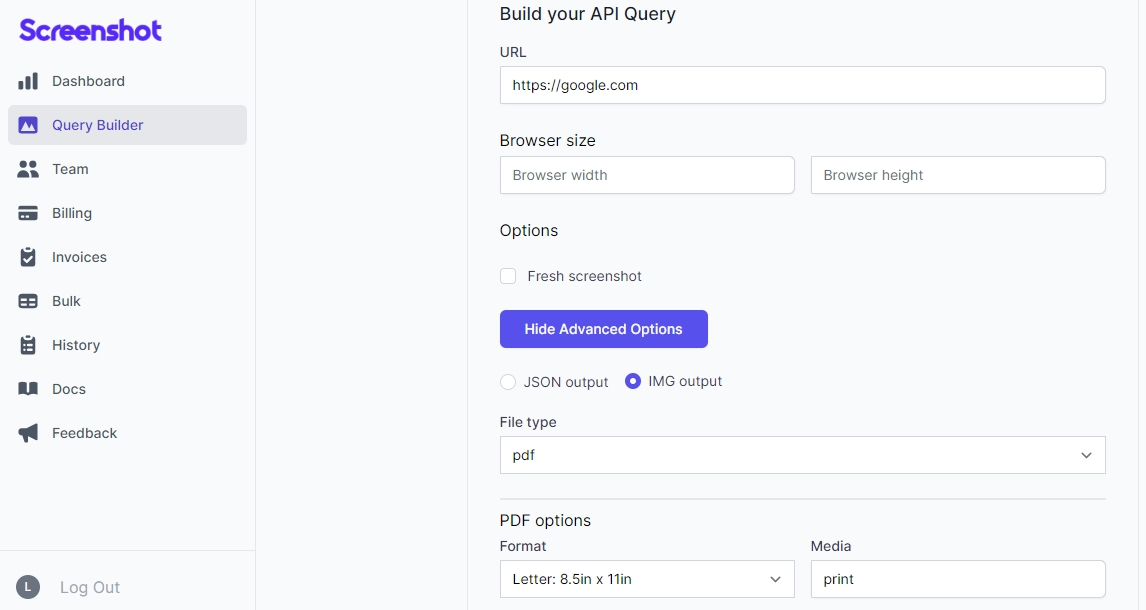
You can take screenshots programmatically by using your own code, selecting options in our query builder, and customizing the screenshot for your specific use case and requirements.
Ready to take that screenshot? Try ScreenshotAPI for free today!
| Method | Best for | Cost | Full page in one file | Bulk / automation | Output quality |
|---|---|---|---|---|---|
| Browser Print to PDF | One-off, quick | Free | No (splits into pages) | No | Medium, can clip |
| Extension (GoFullPage, FireShot) | Single clean page | Free or low ($1/mo GoFullPage; FireShot free or paid) | Yes | No | High for one page |
| Adobe Acrobat Pro | Editing plus conversion | $19.99/user/mo annual | Yes | Limited | High |
| ScreenshotAPI | Many pages, automation | Free tier available, paid from $9/mo | Yes (full_page=true) | Yes (bulk, scheduled) | High, real Chromium |
Capturing the whole page in one file works the same way as when you take a full-page screenshot: the entire scroll is rendered as one surface instead of one screen at a time.
Safari can save an entire page as one continuous PDF with no page breaks. Follow these steps.
For a cleaner file without ads or navigation, switch on Reader View first: tap "AA" in the address bar, choose "Show Reader", then repeat the steps. The result is a single-width PDF sized to your device rather than a clipped A4 page.
If you need to save dozens or thousands of pages, a manual browser step does not scale. A screenshot API renders each page in a real headless browser and returns a PDF from one HTTP request, so you skip the browser fleet, fonts, and ad removal work.
With ScreenshotAPI, set two parameters: full_page=true captures the entire scroll rather than just the viewport, and file_type=pdf returns a PDF instead of an image. A single GET request looks like this:
https://shot.screenshotapi.net/v3/screenshot?token=YOUR_TOKEN&url=https://example.com&full_page=true&file_type=pdfBecause the render runs in Chromium, JavaScript executes, lazy-loaded images resolve, and layout matches the live page before capture. Add fresh=true to bypass the cache when a page has changed.
For a code-first walkthrough, see how to generate a website PDF with Playwright. When you do not control the source, a full-page capture sidesteps page-break math entirely by producing one continuous surface. Use the browser or an extension for a single page, and reach for the API when you need bulk output, scheduling, or a consistent render across machines.
Manual methods work for a page here and there, but they slow down the moment you need scale or consistency. Ready to skip the manual steps? Use the URL to PDF tool to convert any URL to a full PDF with no cut-offs.
The browser scales the live page to a fixed paper size. If the layout is wider than the printable area or the scale is locked at 100%, the right edge or bottom gets clipped. Set scale to "Fit to page" and margins to "Default" to fix most cases.
Capture the page as a single continuous image, then export that to PDF. On desktop, use a full-page extension like GoFullPage; on iPhone, use Safari's "Full Page" screenshot; at scale, use a screenshot API with full_page=true and file_type=pdf.
Yes. On iPhone, take a screenshot in Safari, tap the thumbnail, choose "Full Page", then "Save PDF to Files". The output is one continuous PDF sized to your device. Turn on Reader View first for a cleaner page without ads.
Use a screenshot API instead of saving each page by hand. Send each URL with full_page=true and file_type=pdf, or upload a CSV for bulk processing. ScreenshotAPI runs each capture in real Chromium and can store results to your own cloud bucket.


