How to Save or Print a Webpage as PDF Without Ads

Written By Hanzala Saleem
Updated At June 23, 2026 | 6 min read
Written By Hanzala Saleem
Updated At June 23, 2026 | 6 min read
To save or print a webpage as a PDF without ads, open it in a browser reader mode (Edge, Firefox, or Safari), then choose Print and select Save as PDF. In Chrome, open Print with Ctrl+P or Cmd+P, then untick Background graphics and Headers and footers to drop most ad styling. To do this in bulk or from code, use a screenshot API with an ad-blocking option so every page exports clean automatically.
Saving a web page as a PDF is easy until the ads come with it. Banners, pop-ups, sticky headers, and sidebars all print straight onto the page, wasting space and ink and burying the part you actually wanted.
This guide covers five ways to save or print a webpage as a PDF without ads, from a quick browser print tweak to a one-call API for bulk jobs. Each method lists what it is good at and where it falls short, so you can pick the one that fits the page in front of you.
| Method | Works in | Removes ads | Best for | Limitation |
|---|---|---|---|---|
| Reader mode then Print | Edge, Firefox, Safari | Most ads and sidebars | A single article you want clean | Not supported on every page; absent in Chrome |
| Chrome Print, untick Background graphics | Chrome, any browser | Background ad styling, headers, footers | Quick one-off prints | Inline image ads can remain |
| Print selection (right-click) | Most browsers | Everything outside your selection | Printing one section only | Manual; layout can shift |
| Browser extension | Chrome and others | Ads, nav, clutter before export | Frequent manual cleanups | Adds a third-party tool to your browser |
| ScreenshotAPI Block Ads | Any environment, via API | Ads via a request parameter | Bulk, scheduled, or automated PDFs | Requires an API call or the Query Builder |
The fastest way to save a webpage as a PDF is your browser Print menu. Here is the Chrome version, with the step most guides skip: turning off the settings that carry ad styling into your file.
Open the page, then press Ctrl+P (Windows) or Cmd+P (Mac). You can also click the three dots in the top-right corner and choose Print.
In the dialog, set Destination to Save as PDF. Then open More settings and untick two boxes: Background graphics, which strips coloured ad blocks and banners, and Headers and footers, which removes the URL and date stamps. Click Save and your PDF drops most of the ad clutter.
This handles background and styled ads well. Inline image ads sitting inside the article body can still slip through, which is where the reader-mode method below does a cleaner job.
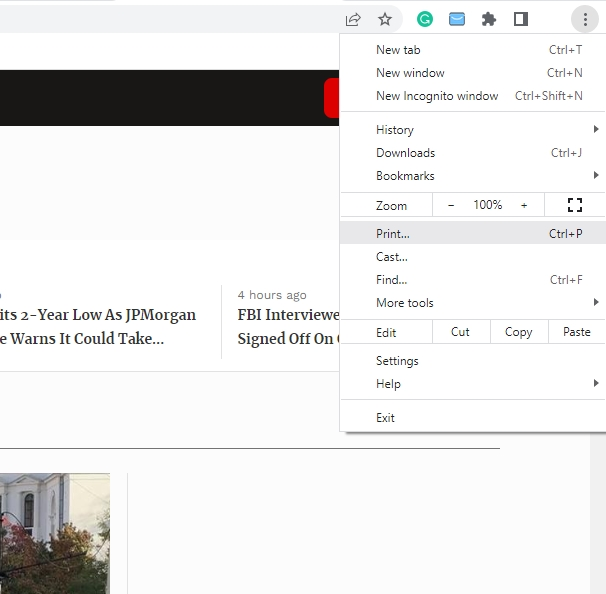
Most other browsers follow a near-identical flow: open Print, choose Save as PDF, then look for the background and header options before saving. The catch is that print settings alone cannot always tell an ad from real content. For pages packed with inline ads, switch to reader mode.
Reader mode rebuilds an article with just the text and key images, dropping ads, navigation, and sidebars before you ever reach the print dialog. It produces the cleanest result of any built-in option. Here is how to reach it in each browser.
Microsoft Edge: open the page and click the Reader mode icon (a book) in the address bar, or press F9. Then choose Print and Save as PDF.
Mozilla Firefox: click the Reader View icon in the address bar or press F9, then Print and Save as PDF.
Safari (Mac and iOS): click the page icon on the left of the address bar and select Show Reader, or press Cmd+Shift+R, then print. On iPhone, tap the AA symbol, choose Show Reader, then use Share and Print.
Two limits to know. Chrome has no reliable reader mode for printing, so use one of the browsers above instead. And reader mode only appears on pages a browser recognises as an article, so it may be greyed out on product pages, dashboards, or apps.
If you want one section rather than the whole page, you can print just a selection and leave every ad behind. Highlight the text you want with your mouse, right-click the selection, and choose Print. In the dialog, the preview shows only what you highlighted. Set Destination to Save as PDF and save.
This is the most reliable way to capture a single recipe, table, or passage without any surrounding ads. The trade-off is that complex layouts can reflow when isolated, so check the preview before saving.
If you clean up pages often and want more control than print settings give you, a print-friendly browser extension lets you delete ads, images, and sections by clicking them, then export the result as a PDF. Tools in this category have existed since well before reader mode was common and still handle messy pages that reader mode refuses to simplify.
The cost is a third-party extension in your browser with access to page content, so install from a trusted source and review its permissions. For occasional use, the built-in methods above are usually enough.
The methods above work page by page. If you need to save many pages, run it on a schedule, or build PDF export into an app, do it with one API request instead of clicking through print dialogs.
ScreenshotAPI converts any URL to a PDF and removes ads through a single Block Ads option, so every export comes out clean without manual cleanup. You can trigger it two ways.
No-code, in the Query Builder: sign in, open the Query Builder from the side menu, click Show Advanced Options, choose PDF from the File type dropdown, and tick Block Ads under the PDF options.
From code, send the same settings as request parameters and get the PDF back in the response. The file type and ad-blocking parameters are listed in the ScreenshotAPI documentation, with examples for Node.js, Python, and cURL.
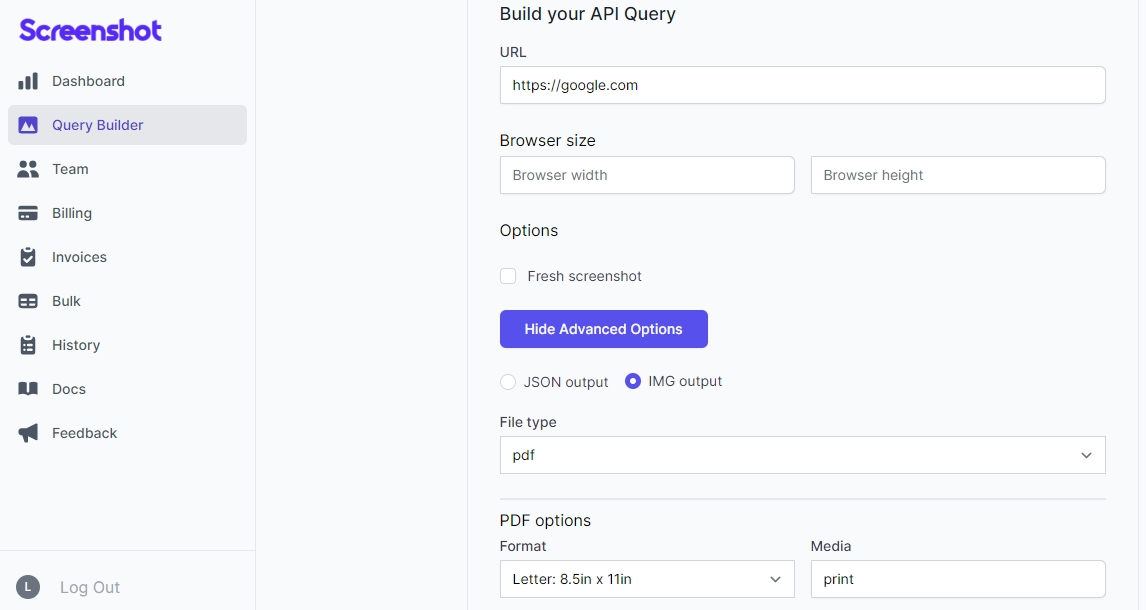
Click Take Screenshot to download the PDF, or copy the generated API query to run the same job from your code. Because the ad-blocking happens server-side on every request, it stays consistent across hundreds of pages, which the browser methods cannot promise.
If you also need long pages captured in full, see how to save a webpage as PDF without cutting it off. To start exporting ad-free PDFs from your own URLs, get started for free.
Ads print because the standard print command captures the full page layout, including banners and sidebars. Browsers cannot reliably tell an ad from real content. To remove them, switch to reader mode first, untick Background graphics in the print dialog, or use a tool with an ad-blocking option.
Yes, but not through a reliable reader mode, which Chrome lacks. Open Print with Ctrl+P or Cmd+P, set Destination to Save as PDF, then untick Background graphics and Headers and footers under More settings. For pages with heavy inline ads, open them in Edge, Firefox, or Safari instead.
Reader mode is fastest for a single article: one click strips ads and sidebars, then you print to PDF. For a section rather than a whole page, highlight the text, right-click, and choose Print to capture only what you selected.
No. Reader mode appears only on pages a browser recognises as an article. It is usually greyed out on home pages, product listings, dashboards, and web apps. For those pages, use the Chrome print settings, a print extension, or an API with an ad-blocking option.
Use an API instead of printing each page by hand. ScreenshotAPI turns any URL into a PDF and removes ads through a single Block Ads option, so you can export pages in bulk, on a schedule, or directly from your own code with consistent results.


